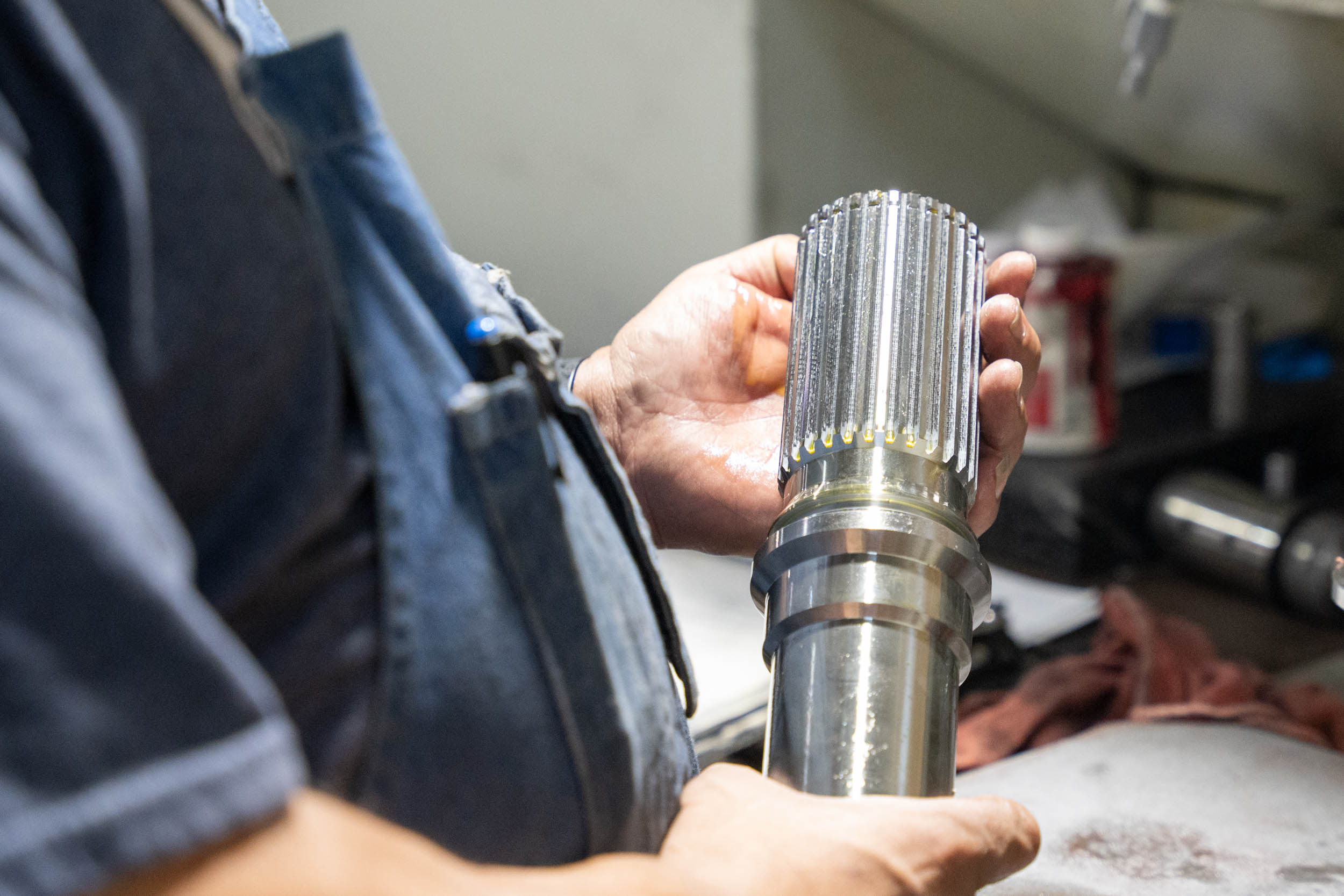
Hobbing and Chamfering in One Setup: Now Available on the Hera Platform


For gear manufacturers who care about surface quality, downstream tool life, and part integrity through heat treat, chamfering has moved from a finishing afterthought to a critical step in the gear manufacturing process. Helios Gear Products is now offering integrated ChamferCut capability on select Hera CNC gear hobbing machines, allowing shops to hob and chamfer in a single setup, enabling precise chamfer definition without a separate machine.
The latest Hera platform to run this capability in production is the Hera 350, now installed and cutting chamfered gears at Hindle Gears in Bradford, UK. Established in 1930 as part of the Hindle Group, Hindle Gears is a subcontract gear manufacturer in Bradford, UK, supporting civil and defense customers worldwide.
What Is ChamferCut Hobbing?
ChamferCut hobbing is a process where a dedicated chamfer tool is mounted on the hob arbor alongside the primary gear hob. After the machine cycles through the hobbing operations, the chamfer cutter operates in the same setup to produce a defined chamfer on both ends of the gear teeth, generating the chamfer form rather than pressing, rolling, or grinding it.
The result is a precise, repeatable chamfer with no secondary burr, which is essential when gears are destined for hard finishing operations like honing or grinding. Sharp edges left by hobbing, if not properly removed, can harden during heat treat and become brittle stress risers. They can also reduce honing tool life significantly when abrasive burr material loads into the finishing tool. A clean, generated chamfer ahead of heat treat eliminates both problems.
ChamferCut is not a new concept in the gear industry. It has been utilized in high-volume automotive and transmission manufacturing for years. What Helios is now bringing to market is access to this process on the affordable Hera platform, supported by their expert support for the machine, hob cutter, and chamfering tool. That means one partner, one support relationship, and no gap between machine capability and cutting tool design.
How It Works on the Hera
On Hera machines configured for chamfering, the chamfer cutter sits on the hob arbor outside the primary gear hob. The machine's CNC axes manage the synchronization between hobbing and chamfering operations within the same part cycle. No separate workholding, no re-fixture, no secondary machine time.


The Hera 200 and Hera 350 lead the Hera lineup in chamfering capability, while the broader Hera line supports the feature depending on application requirements. Helios applications engineers work with customers to configure tooling geometry and process parameters specific to each gear design: module, face width, chamfer angle, and part material all inform the tool specification.
Why Chamfering Matters More Than It Used To
The push toward harder finishing processes and quieter gearboxes has changed how manufacturers think about every upstream operation, including chamfering. Chamfering has grown in importance for a few reasons:
- Honing and grinding are sensitive to incoming part condition. Hardened burrs and sharp edges left from hobbing can damage finishing tools and compromise surface quality. A precisely generated chamfer provides a clean, controlled entry condition.
- Heat treat amplifies edge conditions. Sharp tooth edges become brittle after case hardening. Defined chamfers (produced to a spec, not an approximation) minimize the risk of edge breakout under load.
- Tighter gear designs leave less room for variation. In compact gearboxes, especially those developed for e-drive and high-efficiency power transmission, the chamfer is increasingly an engineered feature, not a cleanup step. Getting it right matters for load distribution and noise.
- Operator safety. Sharp post-hobbing burrs create handling hazards, and manual chamfering generates airborne particles that operators can inhale. Integrated ChamferCut eliminates both risks by removing exposed edges and keeping the process enclosed within the machine cycle.
Setting the Standard: Hindle Gears, Bradford, UK
Hindle Gears is a subcontract gear manufacturer in Bradford, West Yorkshire, established in 1930 as part of the Hindle Group. Hindle manufactures spur and helical gears and shafts from module 0.5 to module 20, in diameters from 10 mm to 1000 mm, with a strong focus on international OEMs across civil and defense markets.
Hindle is a traditional shop. For most of its history, hobbing has been a roughing process feeding a grinding operation, and the hobbing floor ran on older manual machines. As capacity tightened and experienced operators began to retire, the case for a CNC hobber changed. Hindle wanted to reduce its dependence on specialist setup knowledge, protect capacity, and future-proof the department. The Hera 350 is their first CNC hobber.
What moved the decision from worth considering to worth buying was chamfering. Hindle had a family of gears that were hobbed on one machine and then moved to a milling machine to cut a controlled chamfer to print. On some parts, the milling time ran as long as the hobbing cycle itself. Running both operations in one setup on the Hera 350 removed that second machine from the route entirely.
Hindle installed the Hera 350 in spring 2025, specifically drawn to the ability to cut and chamfer gears in the same setup. The machine is now actively cutting and chamfering production gears at their Bradford facility.
Shop Outcomes
- Single-setup hobbing and chamfering. The separate milling operation is gone. Gears are hobbed and chamfered in one setup on the Hera 350, then go straight to heat treat with no wait in queue for a second machine. The chamfer adds about a minute to the hobbing cycle, in place of a milling step that on some parts ran as long as the hobbing cycle itself.
- Less processing time per job. Cutting out the separate chamfer operation saves roughly 6 to 10 minutes on many jobs, with the chamfer generated in the same cycle rather than on a second machine.
- Shorter lead time per batch. The biggest gain is flow, not machine minutes, and most of it comes from cutting the queue. By Steve Wikocki's estimate, a batch that used to run about seven days — roughly three to four days in gear cutting, two to three days waiting in queue, and about two days in milling — now moves in about two, a reduction of roughly 70%.
- Faster, repeatable setups. With no change gears and saved program data, repeat-job setup time runs roughly half of what it was, about a 50%+ reduction when fixtures are loaded in the same position. That also makes it easier to bring new machinists up to speed as experienced operators retire.
- Chamfer quality to print. The chamfer is produced to a controlled, customer-specified form on both flanks of each tooth in a single pass. Hindle's priority is the evenness and consistency of the chamfer, and the Hera 350's rigidity lets them hold that quality while pushing feed rates to bring cycle time down.
"Investing in the CNC hobber helped us future-proof the process as experienced operators retired, but the biggest gain has been bringing chamfering onto the machine itself. We've effectively cut out a separate milling operation, improved workflow significantly, and on some batches reduced lead time from about seven days to around two. The ring loader and repeatability have also made a big difference in day-to-day efficiency."
- Steve Wikocki, Hindle Gears
Tooling: Supplied by Helios
The ChamferCut process requires additional engineering because the chamfer hob is designed for each unique application. Module, pressure angle, face width, and chamfer geometry all inform the tool profile.
Chamfer hobs are designed with asymmetric tooth geometry: an active flank engineered to cut the specified chamfer form, and a passive flank designed to clear the opposing gear flank without interference. This allows both flanks of each tooth to be chamfered in the same pass. Tooling is available for spur and helical gear applications.
Helios' applications team can assist with tool specification, process setup, and qualification.
Who Benefits Most
Automotive transmission suppliers, precision gearbox manufacturers, and contract gear shops supplying defense and industrial customers are among those who stand to benefit most, especially those whose parts go through any of the following downstream operations:
- Gear honing: where burr-free, chamfered incoming parts extend honing tool life and protect surface finish
- Gear grinding: where sharp post-hobbing edges can chip under the grinding wheel
- Case hardening: where undefined edges harden unpredictably and create stress concentration
- Assembly into compact gearboxes: where tooth edge condition affects noise, meshing behavior, and fatigue life